A
Pipeline Safety: For Your Family, Neighborhood, and Community
Available for download in two languages:

Pipelines in Your Community
Available for download in seven languages:
A
Your Role in Pipeline Safety
- Know where pipelines are in your area
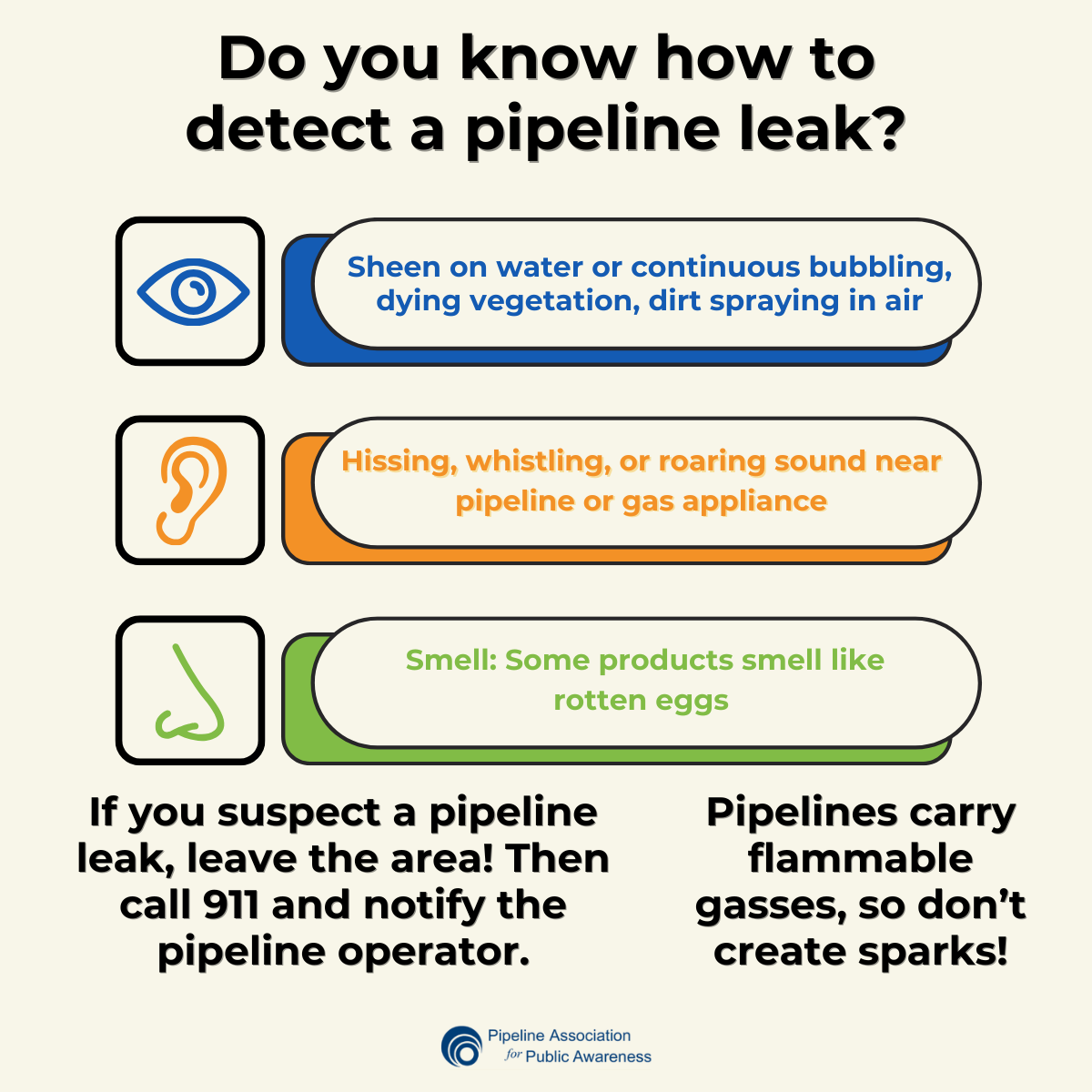
- Recognize signs of a leak (odor, sound, dead vegetation, vapor cloud)
- Call 911 and the operator if you suspect a problem
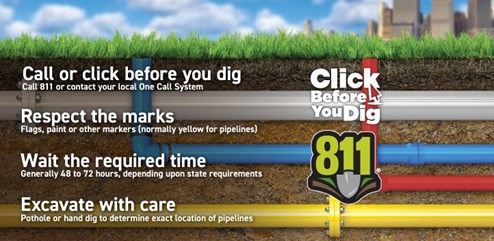
- Call 811 at least 72 hours before digging
Report Damage or Dangerous Activity
Call the pipeline operator if you see:
- Unauthorized excavation
- Exposed pipeline due to erosion
- Any activity that could endanger a pipeline or aboveground facility
Operator emergency numbers are listed on nearby pipeline markers.
Follow Safe Excavation Practices
Excavation is the most common cause of pipeline emergencies.
- Always call 811 before excavation
- View a chart that explains marker flag colors and the lines that they represent.
- Refer to the Common Ground Alliance’s Excavation Safety Best Practices for more information about selecting appropriate equipment and techniques for digging near pipelines.
- Customer-owned lines often include pipelines and piping that run from the meter or other connection points to a customer’s gas appliances or manufacturing equipment. These lines are rarely maintained or located by the pipeline company. If you are planning to excavate near customer-owned lines, contact a local professional who is qualified to verify the location of these lines before digging.
How safe are pipelines? What are the statistics?
Pipelines are the safest and most cost-effective means to transport the extraordinary volumes of natural gas and hazardous liquid products that fuel our economy. To move the volume of even a modest pipeline, it would take a constant line of tanker trucks, about 750 per day, loading up and moving out every two minutes, 24 hours a day, seven days a week. The railroad-equivalent of this single pipeline would be a train of seventy-five 2,000-barrel tank rail cars everyday. These alternatives would require many times the people, clog the air with engine pollutants, be prohibitively expensive and — with many more vehicles on roads and rails carrying hazardous materials — unacceptably dangerous.
Pipelines have a strong safety record compared to trucks and rail. Oil pipeline spills amount to about 1 gallon per million barrel-miles (Association of Oil Pipelines). One barrel, transported one mile, equals one barrel-mile, and there are 42 gallons in a barrel. In household terms, this is less than one teaspoon of oil spilled per thousand barrel-miles.
Pipelines also generally have a better safety record (deaths, injuries, fires/explosions) than other modes of oil transportation. For example, compared to the pipeline record, there are 87 times more oil transport truck-related deaths, 35 times more oil transport truck related fires/explosions, and twice as many oil transport truck-related injuries.
Click here for more statistics.
How Pipeline Routes Are Chosen
Route planning considers:
- Supply and demand
- Environmental impacts
- Landowner input
- Regulatory requirements
- Engineering feasibility
Both natural gas and oil pipeline routes undergo environmental review and require easements from landowners.
A
Natural Gas and Freezing
Natural gas pipelines don’t freeze, at least not on Earth. At minus 260 F and a few psi, natural gas becomes LNG (Liquefied Natural Gas). If a gas pipeline contains a significant amount of water, it may freeze and cause problems in the pipeline, but the gas itself will not freeze.
Water freezing in pipelines is only a possibility for services on gas distribution systems. Pressures and flow are too high on gas distribution mains and gas transmission systems. Freezing would only be discovered when it obstructs gas flow, which would result in a no-gas call to the operator. The operator would need to remove or melt the ice to restore gas flow.
Frequently Asked Questions
The Frequently Asked Questions below have been compiled and grouped by topic.
In some cases, the same question and answer pair may be in more than one FAQ group to help you locate information.
Working with PHMSA
Hazardous Materials Safety
- Hazardous Materials Information Center (HMIC)
- Hazardous Materials Safety FAQs
- Training FAQs
- Security Training FAQs
- Approvals
- Cylinder Approvals: Overfilling Prevention Device (OPD)
- Fireworks Approvals
- Special Permits
- Phmsa's Online CFR (oCFR)
Pipeline Safety
- Gathering Pipeline FAQs
- General Pipeline FAQs
- PHMSA and Pipelines FAQs
- Pipeline Improvement R&D
- Stakeholder Communication


Tongan